
There’s a pattern playing out in boardrooms across industries. A company deploys AI. Ticket volumes drop. Headcount plans shrink. Someone puts up a slide showing cost savings. Applause. And then the next quarter, revenue growth is still flat — or worse, a competitor has quietly pulled ahead on market share.
This is not an AI failure. It’s a strategy failure.
Most organisations have unconsciously defined AI success in terms of subtraction: fewer calls, less manual effort, lower operational spend. These are real wins, and nobody is suggesting they don’t matter. But subtraction has a ceiling. You cannot cut your way to competitive advantage. At some point, the only meaningful measure of AI maturity is what it adds — to revenue, to customer lifetime value, to the market position you hold five years from now.
The companies that will look back on this decade as a defining moment are the ones that made a different choice: to point AI at growth.
Why CX Is the Highest-Value Target for AI
Customer experience is not just a service function. It is, in the most literal sense, the sum of every value exchange between a company and the people who fund it. Every touchpoint is a data event. Every interaction is a signal. And the lifecycle that runs from first awareness through advocacy is the most information-dense, highest-stakes process any organisation manages.
AI is uniquely suited to this environment. Unlike most enterprise systems that automate known processes, AI can find patterns in complexity — the non-obvious signals that predict churn before the customer knows they’re leaving, the micro-segment of high-potential prospects being underserved, the precise moment in an onboarding journey where a nudge converts a passive user into an active one.
This is where AI stops being a cost lever and starts being a growth lever. And the gap between the two is not technical — it is strategic.
What Growth-Oriented AI Actually Does
Across the customer lifecycle, AI-for-growth looks materially different from AI-for-efficiency:
- Acquisition: Propensity models identify the highest-quality prospects and match them to the right proposition at the right moment — lifting conversion rates and reducing wasted spend on audiences unlikely to convert
- Onboarding: Adaptive journey orchestration replaces rigid, one-size-fits-all sequences with flows that respond to individual behaviour in real time, reducing early drop-off and accelerating time-to-value
- Engagement: Hyper-personalisation — built on behavioural, transactional, and contextual signals — transforms generic communications into relevant, timely experiences; research consistently shows personalised experiences drive 10–15% revenue uplift
- Retention: Predictive churn models give teams enough lead time to intervene meaningfully, shifting retention from a reactive scramble to a proactive system
- Advocacy: AI surfaces satisfied customers at the right moment to invite referrals, reviews, and upsell conversations — converting loyalty into a compounding revenue asset
The through-line in every one of these use cases is the same: AI reads the customer more accurately, acts more precisely, and learns continuously. The outcome is not lower cost per interaction — it is higher value per customer.
Realigning AI KPIs: From Cost Savings to Revenue Growth
Here is the structural problem most organisations are sitting on: their AI investments are measured on a scorecard built for a different objective.
Cost-per-ticket. Handle time. Deflection rate. Headcount avoided. These metrics tell you what AI removed from the system. They say nothing about what it created. And when leaders see only the efficiency dashboard, efficiency is all they’ll ever get.
Realigning AI KPIs toward growth is not a measurement exercise — it’s a strategic declaration. It signals, internally and externally, that AI is a business driver, not a back-office optimisation tool.
| Efficiency KPI (Old Lens) | Growth KPI (New Lens) |
| Cost per support ticket | Revenue per customer interaction |
| Deflection rate | Conversion rate lift from AI-assisted journeys |
| Headcount saved | Incremental revenue per AI recommendation |
| Process automation rate | Share of wallet growth from personalised offers |
| Average handle time reduced | CLV delta post-AI intervention |
| Response time improvement | Churn reduction rate attributable to AI retention models |
Making this shift requires three things. First, attribution architecture — the ability to connect AI actions to downstream revenue outcomes, not just operational metrics. This means building models that trace a personalised offer through to purchase, or a retention intervention through to renewed contract value. Second, cross-functional ownership — AI growth KPIs cannot live only in the technology or CX team. They need to be reviewed in the same forums as pipeline and P&L. When the CFO and CMO are seeing AI measured in revenue terms, the conversation — and the funding — changes. Third, an experimentation culture — growth KPIs only improve if teams are running controlled tests, learning what works, and scaling rapidly. AI without a feedback loop is just automation.
The Integration Gap Is Holding Companies Back
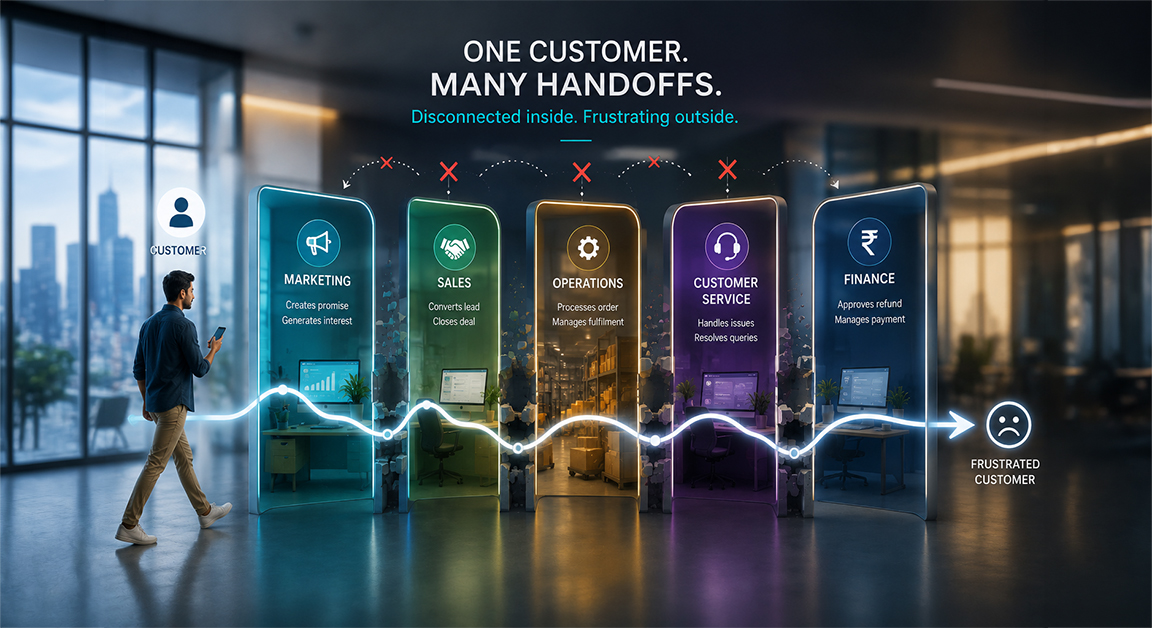
The reason more organisations have not made this shift is structural. AI tools, in most companies, are still sitting outside the flow of business. They operate as standalone applications rather than as embedded decision engines within the customer journey.
Industry data bears this out: a significant majority of firms using AI are running it as a point solution rather than as an integrated capability. The contrast with high performers is stark — companies that embed AI within core workflows and customer processes consistently report substantially higher business value from their AI investments.
At Hansa Cequity, we see this integration gap repeatedly with clients across BFSI, retail, and consumer sectors. The organisations that break through are not necessarily those with the most sophisticated models. They are the ones who have connected data, decisioning, and channel execution into a coherent system — one that can sense a customer signal, interpret it, and act on it within the same interaction.
That is not a tool problem. It is a design problem. And it is entirely solvable.
Agentic AI: Where Growth Scales
The next evolution in AI architecture is already creating distance between leaders and followers. Agentic AI — systems where multiple AI agents work in concert to plan, execute, and learn across complex tasks — is moving from pilot to production in the most forward-thinking organisations.
In a CX context, this means AI that doesn’t wait to be triggered. A well-designed agentic retention system, for example, continuously monitors the customer base, identifies deteriorating relationships, generates personalised intervention strategies, selects the optimal channel and timing, executes the outreach, and feeds outcomes back into the model — all autonomously, at scale, and with minimal human intervention except where judgment genuinely adds value.
This is not a marginal improvement on what AI does today. It is a step change in the scope of what AI can own — and therefore in how much growth it can drive.
The Leadership Imperative
None of this happens without a deliberate decision at the top. AI roadmaps default toward efficiency because efficiency is easier to measure, easier to justify, and easier to explain to a sceptical board. Growth is messier. It requires patience, experimentation, and a willingness to instrument outcomes that take months to materialise.
But that difficulty is also the moat. If growth-oriented AI were easy, everyone would already be doing it. The companies willing to make the harder investment — in data integration, attribution modelling, cross-functional alignment, and agentic architectures — are the ones who will find, a few years from now, that their customer base is more valuable, more loyal, and more defensible than anything a cost-reduction programme could have built.
The question every CX and marketing leader needs to put on the table today is not “How much is AI saving us?” It is “How much is AI growing us?” If the answer is unclear, that is both the problem and the opportunity.