AI is lifting the workers already in their jobs — and thinning the ranks of those trying to land one.
When Google published its first “AI and the Economy: ATLAS” report on July 23, 2026, the headline practically wrote itself: AI is helping workers, not replacing them. Drawing on 15 million de-identified interactions across Gemini App, AI Mode, and the Gemini API — spanning more than 150 countries, 140 languages, 800 occupations, and 4,000 tasks — it is one of the largest observational studies of real-world AI use to date
The reassuring narrative is real, and it is backed by serious data. But it is only half of a more complicated story. For customer experience, marketing, and business leaders trying to make workforce decisions, the honest answer lives in the tension between two things that are both true at once: AI is overwhelmingly augmenting how people work today — and it is already reshaping who gets hired tomorrow.
Here is the rounded view.
What Google’s Study Actually Found
The ATLAS report’s central finding is about breadth without depth. AI now touches occupations covering roughly 88% of the U.S. workforce — but within any single job, it is used for only about 21% of tasks on average
That gap matters. It means AI has spread almost everywhere, but it has automated almost nothing end-to-end. The dominant pattern is collaboration, not substitution:
- Most workplace AI interactions are assistive — ideation, research, writing, and learning — rather than fully automated handoffs. True end-to-end automation remains limited
- It’s not just white-collar work. Manual and technical workers — auto mechanics, industrial machinery repairers — use AI for real-time diagnostics, troubleshooting, and on-the-job learning, often leaning on multimodal tools like images and video
- AI has broken the English barrier. English accounts for only about a third of global conversations, and users don’t abandon their native languages even for complex work
- Work is a minority of usage. More than 86% of AI interactions happen outside of work — shopping research, household tasks, and navigating government processes like taxes, licenses, and fines
The takeaway Google emphasizes: AI is behaving less like a replacement and more like a general-purpose assistant woven into the texture of daily life and work.
Why the “Augmentation” Story Holds Up
Google isn’t alone in this reading, and that’s what makes the augmentation thesis credible rather than self-serving.
In India, the evidence for AI-as-growth-engine is striking. The country added roughly 2.9 lakh (290,000) AI-linked roles in 2025, with AI hiring projected to rise another 32% in 2026 to nearly 3.8 lakh roles. Demand for generative AI and LLM skills jumped nearly 60%.
Adoption is deepening, too. The NASSCOM AI Adoption Index scores India at 2.45 out of 4, with 87% of enterprises actively using AI solutions as of December 2025, and a McKinsey survey of 1,993 firms found 88% of organizations using AI in at least one function in 2025.
This is the constructive half of the story: new roles, new skills, and measurable productivity gains, with AI extending human capability rather than erasing it.
The Other Half: Where AI Is Already Displacing Work
Here’s what a Google usage study — by design — can’t capture. Observing how people use Gemini tells you about augmentation. It tells you nothing about the workers who were never hired, or the roles quietly eliminated, because AI absorbed the task.
And that displacement is now measurable:
- AI has become the leading stated reason for layoffs. In May 2026 alone, U.S. employers announced just over 97,000 job cuts, and nearly 40% were attributed to AI — up sharply from 7% in January, 10% in February, 25% in March, and 26% in April. Cumulative AI-linked cuts hit 87,714 in the first five months of 2026, already exceeding the 54,836 for all of 2025.
- Entry-level workers are absorbing the shock. A Stanford study (“Canaries in the Coal Mine”) by economists Erik Brynjolfsson, Bharat Chandar, and Ruyu Chen found a 13% relative decline in employment for workers aged 22–25 in the most AI-exposed occupations — rising to roughly 16% in the November 2025 revision — with software developers and customer service representatives hit hardest (around 20%). Over the same period, employment for workers aged 35–49 in the same fields grew by 6–9%.
The layoff data and the augmentation data aren’t contradictory. They describe different populations: those already employed, who use AI to do more, versus those on the margins — junior candidates and automatable roles — who feel the squeeze first.
The Net-Effect View: Churn, Not Apocalypse
The most useful frame comes from the World Economic Forum’s Future of Jobs Report 2025, which models the net effect rather than picking a side.
Over 2025–2030, structural labor-market transformation is projected to create the equivalent of 170 million new jobs (14% of today’s employment) while displacing 92 million (8%) — a net gain of about 78 million jobs, or 7%, but with a total churn of 22% of all jobs.
Crucially, employer intentions cut both ways: a majority of employers plan to hire talent with specific AI skills, while 41% anticipate reducing their workforce where AI can automate tasks.
Net positive — but only if the 92 million displaced can move into the 170 million created. That transition is not automatic. It is a policy, reskilling, and leadership problem.

What This Means for CX and Business Leaders
For those of us building customer experience and marketing organizations, the ATLAS findings are directionally encouraging but strategically incomplete. A few grounded implications:
1. Design for augmentation, not headcount arbitrage.
The evidence says AI’s near-term value is a productivity multiplier — 21% of tasks, not 100% of jobs. CX teams that deploy AI to remove drudgery (summarizing tickets, drafting responses, surfacing insights) while keeping humans on judgment and empathy will outperform those chasing pure cost-cutting.
2. Protect and rebuild the entry-level pipeline.
The Stanford finding is the quiet emergency. If AI erodes junior roles, you erode your future senior talent. Rethink apprenticeships so early-career staff learn with AI rather than being replaced by it.
3. Treat reskilling as core strategy, not HR overhead.
With a majority of employers wanting AI skills and AI engineer hiring up roughly 60% year-on-year in markets like India, the competitive edge goes to organizations that build AI fluency internally — not just those that buy tools.
4. Watch the non-work signal.
The fact that 86% of AI use is outside work — including shopping research — is a customer-experience story in itself. Your customers are already using AI to research, compare, and decide. Your CX strategy should assume an AI-assisted customer on the other side of every interaction.
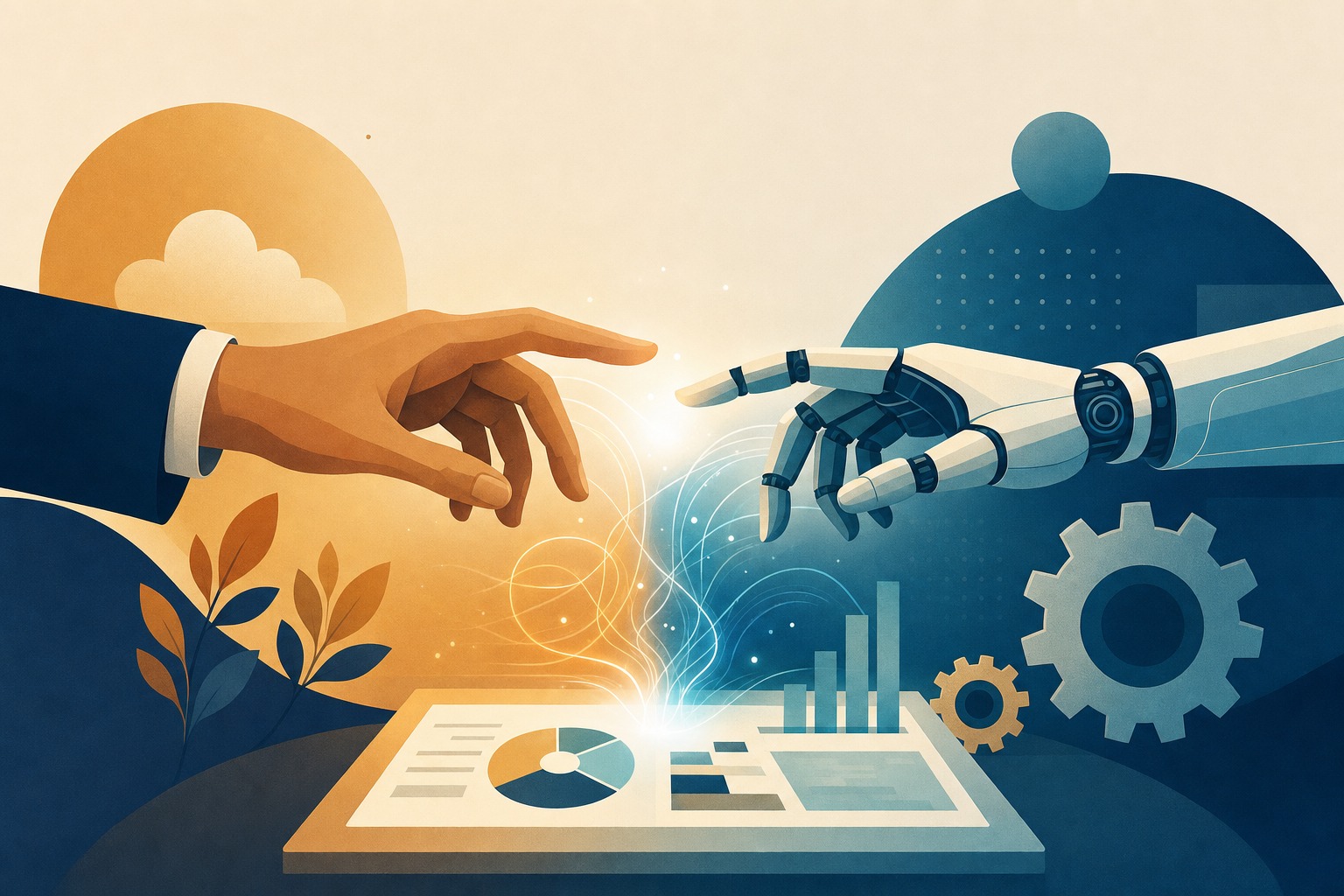
Is AI helping workers or replacing them? The most accurate answer is it is doing both, unevenly, at the same time.
Google’s ATLAS report is a valuable and largely optimistic corrective to the “robots are taking all the jobs” panic — and the augmentation it documents is genuine. But a study of how people use one company’s AI tools is, structurally, a study of the people still in the room. It can’t see the door.
The mature position for leaders isn’t to pick the reassuring headline or the alarming one. It’s to hold both: use AI to make your people dramatically better and take active responsibility for the ones the technology puts at risk. The organizations that get the future of work right will be the ones that refuse to choose between those two truths.