
In 2026, the most decisive “customer” in your category may not be a human. It will be an AI agent — armed with your customer’s complete purchase history, budget, preferences, and delegated authority to buy. If your brand is not legible, credible, and transaction‑ready for that agent, you will simply not be shown. Not ranked lower. Not shown at all.
This is not a future scenario. At the India AI Impact Summit in New Delhi on February 16, 2026, Mastercard demonstrated what it called India’s first fully authenticated agentic commerce transaction — executed on real cards issued by Axis Bank and RBL Bank, with payments processed via Cashfree, Juspay, PayU, and Razorpay for merchants including Swiggy, Instamart, and Tira — though in a controlled sandbox environment, with full commercial rollout pending regulatory clearanceThe competitive line has moved. The question for every CMO and CX leader is no longer if agents will mediate demand — but whether your brand will be visible, trusted, and chosen when they do.
The Numbers That Should Alarm Every Marketer
The pace of the shift is being captured in data, and it is remarkable.
Adobe Analytics, tracking over one trillion visits to U.S. retail sites, found that traffic to retail websites from generative AI sources jumped 1,200% compared to July 2024 levels, in just seven months. During the November–December 2025 holiday season, AI‑driven referrals to retail sites surged 769% in November and 673% in December 2025, year-on-year.
A July 2025 Kearney survey of 750 U.S. consumers found that 60% of shoppers expect to use agentic AI to make purchases within 12 months. Experts at the India AI Impact Summit 2026 put it more starkly: by 2026, AI agents will no longer just recommend products — they will be authorised digital proxies making multi‑trillion‑dollar decisions.
Here is perhaps the most important statistic for anyone still treating SEO as their primary visibility strategy: For commercial and product discovery queries in particular, studies find only 6–12% overlap between ChatGPT’s citations and Google’s top 10 organic results — meaning your search rankings are an unreliable predictor of AI visibility in shopping contexts. Your search rankings no longer predict your AI visibility. They are almost entirely different leaderboards.
From SEO to GEO to SOM: The New Visibility Stack
The old game was: rank on Google. The next game is: appear in AI responses. The winning game is: be the brand that agents actively recommend and transact with.
This has spawned an entirely new discipline — Generative Engine Optimisation (GEO) — distinct from and increasingly more important than traditional SEO for brand discovery. Unlike SEO, which optimises for keyword ranking, GEO focuses on semantic footprint, fact density, structured data, and entity consistency — signals that AI systems use when grounding their responses.
At the granular level, this translates into Share of Model (SOM): how often and how favourably your brand is mentioned when LLMs are queried about your category. Research using Jellyfish’s proprietary Share of Model platform reveals how fragile and variable this metric is. In the Italian laundry detergent market, Ariel’s SOM ranged from nearly 24% on Llama to less than 1% on Gemini. Some brands disappeared entirely from at least one model. This binary “in‑or‑out” dynamic is fundamentally different from search, where brands at least appear low in rankings — in LLMs, absence means invisibility, full stop.
The SOM framework breaks into three measurable sub‑metrics:
- Brand mention rate: How often your brand appears across leading LLMs.
- Human‑AI awareness gap: The disparity between human brand recall and LLM brand recall — often a sharp and revealing delta.
- Brand and category sentiment: The reasons LLMs associate with recommending (or not recommending) your brand, i.e., the strengths and weaknesses the model attributes to you.
Pernod Ricard discovered this gap when its head of digital, Gokcen Karaca, found that Ballantine’s Scotch — a mass‑market product — was being mislabelled as a prestige brand by leading AI models. His team’s fix: systematically prompt major models with real buying‑journey questions, catalogue model responses, and iteratively rewrite product and web copy until LLMs mirrored the intended positioning. Danone now runs a similar always‑on monitoring programme, making targeted corrections when distortions surface in real time.
McKinsey’s February 2026 fashion and retail webinar echoed the urgency: brands and retailers investing in agentic search on their own websites are “absolutely seeing a lot of customer growth in agentic search traffic.” Interestingly, McKinsey also found that some larger, established brands are less well‑represented on AI assistants than disruptive challenger brands — suggesting that historical brand equity does not automatically translate into AI visibility.

The Three Agentic Relationships Every Brand Must Design For
There is not one “agentic channel.” There are three structurally different modes of AI‑mediated interaction that are now coexisting in the marketplace. You need to design explicitly for each.
1. Brand agents serving humans
Your AI agents — embedded in your app, website, or contact centre — that help customers explore, decide, and act. Capital One’s Auto Navigator “Chat Concierge” checks dealer inventory, schedules test drives, estimates trade‑in values, and handles financing queries before a buyer steps into a showroom. True Fit, the fashion analytics platform, launched an agentic AI shopping experience in February 2026 powered by 20 years of proprietary fit data — giving its platform a recommendation layer no horizontal AI can replicate.
2. Consumer agents acting across brands
General‑purpose agents — ChatGPT, Claude, Gemini, Perplexity — that act as the user’s personal representative across every brand simultaneously. The moment one decides to buy something, they’ll not open ten tabs or read 10 reviews. They’ll just ask an agent to scan the market, factor in price, delivery, return policies and give a recommendation they can trust.
3. Full AI‑to‑AI intermediation
Both sides are automated. OpenAI’s Instant Checkout combined with Walmart’s “Sparky” AI means a consumer can say “plan meals for next week and restock essentials” — and the entire journey from intent to delivered groceries is handled without a human search, browser, or checkout screen. Visa and Mastercard have now formalised the payments infrastructure for this: Visa Intelligent Commerce and Mastercard Agent Pay both use tokenised, registered AI agent credentials to execute transactions on behalf of users — with pre‑defined limits, authorisation, and fraud controls built in.
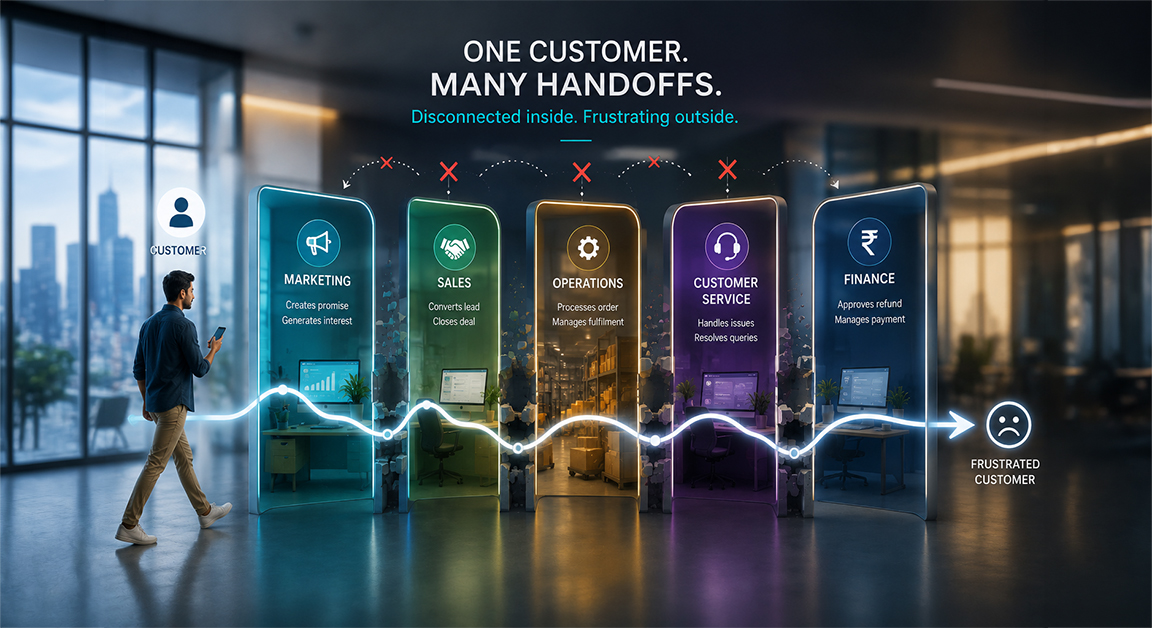
The strategic implication: your customer journey maps are incomplete if they only show human touchpoints. Every key journey needs an “agentic overlay” — where do agents enter, what do they look for, and what can stop them from choosing you?
Stage 1: Decide Where You Actually Need an Agent
The first move is strategic restraint. Deploying AI into customer journeys where it is unwelcome is as brand‑damaging as a rude service rep.
eMarketer’s 2026 agentic AI retail analysis is crisp on where the shift happens fastest: “time‑intensive but low‑risk tasks.” Price comparisons, credibility checks, return policy scanning, review validation, and repeatable planning decisions (outfits, gifting, weekly groceries) will go agentic first. Amazon’s decade‑long path — from Dash Buttons to Dash Replenishment to Subscribe & Save (active in 23% of U.S. Amazon households by 2024) to Alexa+ AI’s multi‑step shopping orchestration — is the clearest demonstration of how consumer comfort with delegation scales when friction is real and stakes are low.
Resistance remains high in identity‑linked, emotionally rich, or high‑stakes domains: gifts, luxury purchases, healthcare decisions, financial life choices, specialist hobby gear. Lamborghini’s CEO has been explicit: buyers do not want a self‑driving Lamborghini; the experience of driving is the product. The same logic applies to a Patek Philippe appointment or an Hermès discovery visit — the journey is the value.
The most sophisticated brands are now mapping journeys into three buckets and being publicly intentional about it:
- Automate fully: low‑stakes, high‑volume, repeatable flows — replenishment, service FAQs, plan selection.
- Augment: AI handles research, comparison, and form‑filling; humans own empathy, negotiation, and judgment.
- Protect as human‑first: declare certain moments “AI‑free by design” — and market that as a premium signal, not a capability gap.
Stage 2: Make Customers Choose Your Agent Over Theirs
The structural tension at the heart of agentic marketing: consumers will default to agents they control — ChatGPT, Claude, Gemini — because they are perceived as fiduciaries, unbiased advocates acting solely in the user’s interest. Consumer Reports is actively building personal AI agents with the explicit mandate to “prioritise user interests above all else.”
Independent agents also hold a data advantage: they accumulate preferences and history across every brand, category, and context, giving them a richer cross‑domain profile than any single brand’s CRM.
Your brand agent wins by doing what independent agents cannot.

Weaponise proprietary knowledge
Sephora’s AI stack is the reference case: a product catalog with deep shade and formula taxonomies, Color IQ technology capable of distinguishing approximately 140,000 skin tones, and profiles from more than 34 million Beauty Insider members. When a shopper asks for a foundation recommendation, the agent draws on their exact skin tone, purchase and return history, and real‑time store inventory — precision that no horizontal agent with scraped catalog data can simulate. Customers using these tools are three times more likely to purchase, and returns have dropped roughly 30%.
For Indian brands, equivalents might be: a telco agent that knows network quality at your home address and your top‑up patterns; a fashion retailer that knows your size, body type, and seasonal preferences from years of purchase history.
Position human escalation as a feature
ServiceNow’s agent resolves roughly 80% of queries autonomously and routes the rest to human specialists who review AI drafts and decide — cutting complex case resolution times by 52%. AG1 trained its agent like a new support hire (brand tone, back‑end access, live customer data), achieving perfect scores in 99% of AI interactions while keeping humans on every review and community touchpoint. Vuori’s AI now manages roughly 40% of all chat conversations, freeing specialists for high‑value connections.
The brand communication reframe: “If it feels off, a human steps in and overrides.” In an era of AI hallucinations and fatigue, escalation‑on‑demand is a premium feature.
Compete on responsible AI, not just UX
Research from discrete‑choice experiments with over 3,000 UK participants shows that in sensitive domains like pension planning and investment management, privacy and auditability often outrank raw product performance as adoption drivers. When responsible‑AI features were embedded into product design, predicted adoption for a pension planning app jumped from 2.4% to over 63%.
Salesforce data reinforces this: 72% of consumers want clear disclosure when they are interacting with AI rather than a human. Transparency and control are not legal disclaimers — they are product features that close the trust gap with independent agents. Your agent should clearly label itself, explain its recommendations, and make the “talk to a human” path obvious and effortless.
Stage 3: Make Other Agents Choose Your Brand
Inevitably, many of your customers will simply tell their independent agent: “Handle it.” That makes machine‑to‑machine marketing your next growth frontier.

Plug into the agent economy
Instacart’s dual‑track play remains the strategic blueprint: build internally (Ask Instacart, a ChatGPT‑powered search within its own app) and plug in externally (a ChatGPT plugin that turns “How do I make an easy chocolate cake?” into a pre‑filled Instacart cart inside ChatGPT).
Shopify has taken this further by exposing what it calls “agentic storefronts” — structured product data feeds that AI systems like ChatGPT, Perplexity, and Copilot can ingest directly, turning a conversational query about a product into a ready‑to‑buy option from a Shopify merchant, settled via Stripe’s Instant Checkout. Your product catalog, pricing, return policy, and availability data are now being syndicated into the reasoning engines of agents who own the consumer conversation. If your data is not structured, clean, and machine‑accessible, your products are invisible before they are even considered.
For CPG brands particularly, this means a foundational restructuring of product data and APIs is now a commercial priority, not an IT hygiene task.
Run an always‑on “Share of Model” programme
Both Pernod Ricard and Danone treat SOM as an ongoing programme, not a project. Harvard Business School research adds more aggressive levers to the toolkit: Strategic Text Sequences (STS) — algorithmically generated strings added to product pages — have been shown in controlled experiments to lift a product from excluded to top‑recommended status in LLM outputs. LLMs also display latent biases towards global brands and AI‑generated content that can be harnessed or countered depending on your competitive position.
More importantly, next‑generation reasoning models are making LLM decision chains transparent. When Perplexity’s R1 recommends a wireless charger, it shows the sources it used, the criteria it weighed (price, compatibility, reviews), and why the winning product was chosen. That is a live brief for your product and content teams: exactly which claims, features, and price points the AI system rewards.
Master prompt‑level optimisation
Carnegie Mellon research shows that simply changing synonyms in a search prompt — “best VPN service” versus semantically equivalent alternatives — can shift brand recommendations by up to 78% across models. That means prompt mining — the actual language your customers and their agents use — is the new keyword research.
Concretely: mine your search logs, chat transcripts, and contact‑centre interactions for natural‑language query patterns. Test those prompts across ChatGPT, Claude, Gemini, and Perplexity. Map which phrasings surface your brand and which ones lose you. Then build content, FAQs, and product copy that performs across those variations — and retest quarterly as models are updated.
GEO best practices for 2026 include:
- Semantic footprint expansion: Publish content that covers topic clusters and related entities, not just one keyword per page.
- Fact density: Add statistics, citations, and unique insights — AI systems prioritise factually rich, authoritative sources.
- Structured data depth: Implement schema markup, product feeds, and entity datasets so LLMs can parse and extract your information reliably.
- Entity consistency: Ensure your brand name, product categories, SKUs, and service descriptions are consistent across every digital surface — mismatches confuse LLM grounding.
- Answer Engine Optimisation (AEO): Structure content to directly answer the questions agents are asked, not just the keywords humans search.

The Payments Infrastructure Is Now Ready — Are You?
One of the last “this is still theoretical” objections to agentic commerce has been settled. Both Visa and Mastercard have formally launched agent tokenisation platforms — Visa Intelligent Commerce and Mastercard Agent Pay — that allow AI agents to execute purchases using pre‑authorised, tokenised credentials with user‑defined spending limits, merchant registrations, and fraud controls built in.
Mastercard’s Agent Pay demonstration at the India AI Impact Summit 2026 in New Delhi is particularly significant for Indian brands: it signals that the payments rails for authenticated secure agentic transactions are being laid now in this market. Every agent‑initiated transaction is tied to a registered, verified AI agent credential, with user‑defined permissions and a full audit trail for disputes.
The implication for brands: if an agent tries to transact with you and you are not integrated with these new agent payment rails, the transaction fails — and the agent will route to a brand that is. Commerce infrastructure readiness is now a competitive differentiator, not just an IT consideration.
The 12‑Month Brand‑to‑Agent Readiness Agenda
Translating this into a concrete agenda for CMOs, CDOs, and CX leaders in India and beyond:
1. Run an agentic brand audit (Q1 2026)
Instruct ChatGPT, Claude, Gemini, and Perplexity to research and buy in your category. Document how they describe your brand, which SKUs they pick, where you disappear, and what they say about your competitors. This is your SOM baseline.
2. Redesign journey maps with agents as first‑class actors
For each major journey — acquisition, onboarding, service, retention, replenishment — explicitly mark where brand agents help, where consumer agents intervene, and where humans must own the moment. Decide what you will automate, augment, or protect.
3. Build one flagship brand agent with proprietary data
Pick a high‑volume, low‑stakes domain where your first‑party data creates a genuine advantage. Wire it to real‑time product, customer, and operational data. Build clean human escalation. Launch, measure, iterate.
4. Launch a GEO + SOM optimisation loop
Establish a quarterly process: prompt testing across major LLMs, structured data and schema updates, content fact‑density improvements, and llms.txt hygiene. Track SOM as a KPI alongside share of voice and share of search.
5. Integrate with agent payment infrastructure
Map your commerce systems against Mastercard Agent Pay and Visa Intelligent Commerce. Ensure your APIs can receive and fulfil agent‑initiated orders. Integrate with agentic storefronts on Shopify, or equivalent platforms in your category.
6. Make responsible AI your public brand differentiator
Publish principles on privacy, oversight, and explainability. Label AI clearly in every interaction. Build redress mechanisms. Turn trustworthiness into a reason to choose your brand agent over a neutral one.

The Shift in Plain Language
Here is the simplest way to communicate this shift internally: You are no longer designing for human attention alone. You are now also designing for algorithmic shortlisting.
AI agents are infinitely patient, hyper‑informed, ruthlessly objective, and impossible to charm with a clever ad. They reward clear product claims, clean data, fair pricing, consistent identity, and a track record of doing what your brand says it does. The brands that win the agentic era will not necessarily be the most creative or the loudest — they will be the most machine‑readable and most trustworthy.
The Indian market is at an inflection point: Mastercard has completed the first agentic transaction here, Reliance Jio and Amazon India are expanding AI shopping features rapidly, and consumers in Tier 1 and Tier 2 cities are already using LLMs to research purchases before visiting stores or apps. Brands that move now — building SOM programmes, integrating with agent payment rails, and redesigning at least one journey for agentic interaction — will be the ones that agents recommend by default.
The question is not whether your brand is ready for agents. The question is: when an agent comes looking, will it find you — or your competitor?