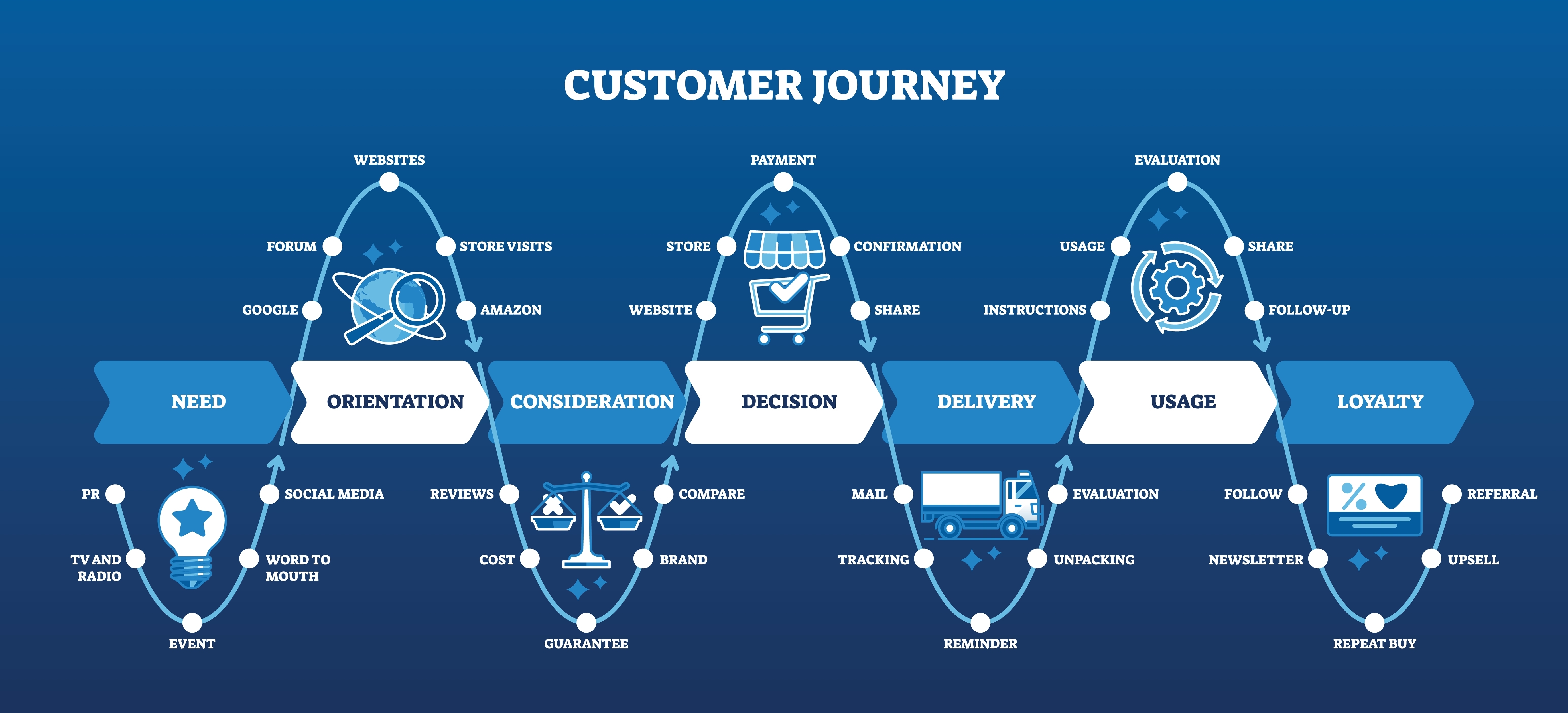

This is a question that has been troubling me for the longest time. Our teams sometimes make superhuman effort to deliver/over deliver to great customer experiences but quickly realise that it is not only about on phone call or interaction, it’s a chain of sequential and random events, very often outside a CX Centre’s control.
Customers do not experience your organisational chart. They experience one brand.
They do not care that marketing owns the campaign, sales own conversion, operations own fulfilment, the contact centre owns complaints, and finance owns refunds. When something goes wrong, they see a single logo—and expect a single organisation to take responsibility.
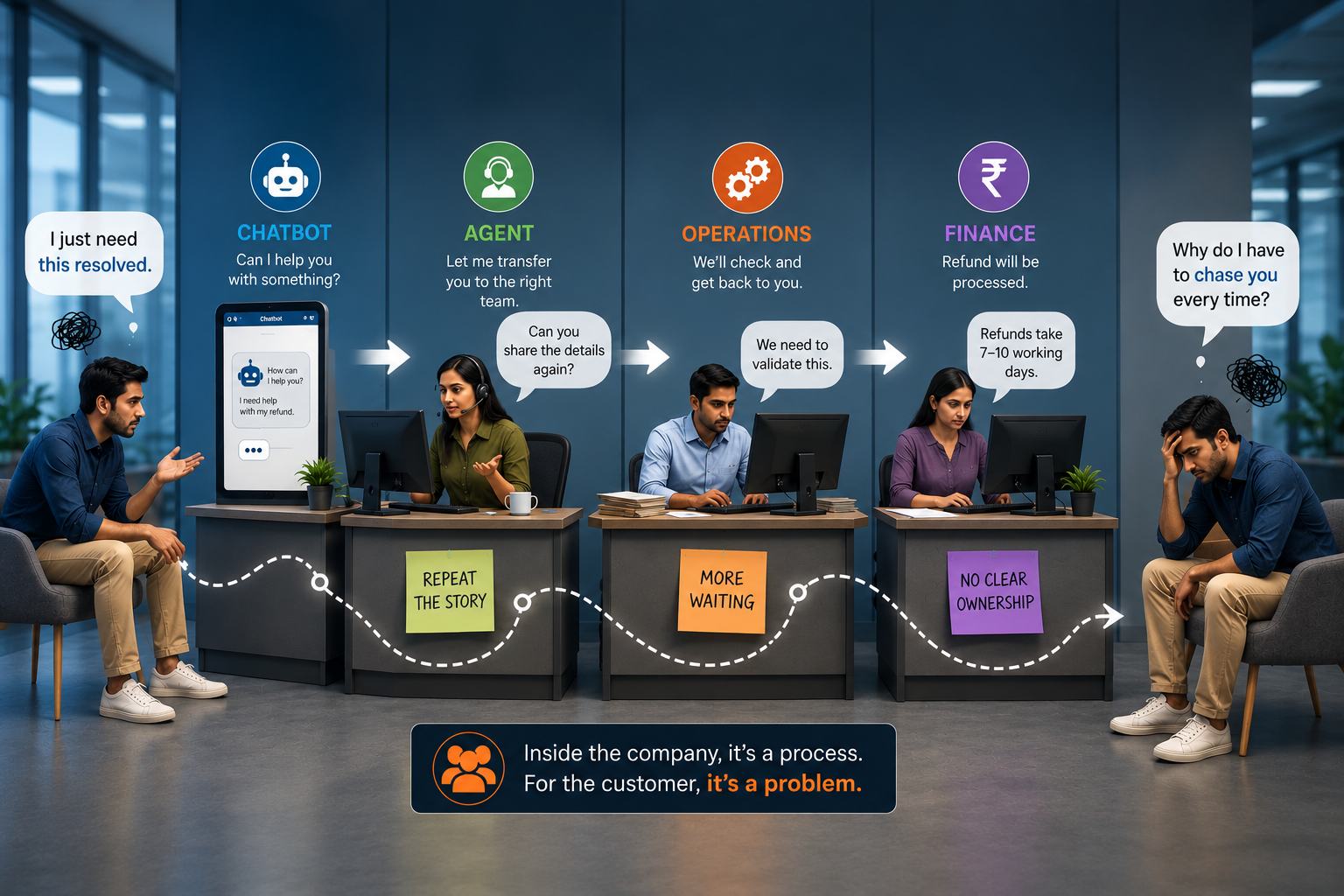
That is why many customer experiences fail not at the front door, but at the handoffs.
The advertisement is slick. The app is intuitive. The offer is relevant. The sales executive is responsive. Then the customer has to submit the same document again, explain the problem to a third agent, wait for a callback that never comes, or receive a cheerful cross-sell message while their complaint is still unresolved.
At that point, no amount of brand purpose or digital polish can save the experience.
The customer has met the real organisation.
The Handoff Problem
A handoff occurs whenever a customer’s need moves between functions, systems, channels, teams, or external partners.
It may be obvious: a chatbot transfers a customer to an agent, or sales asks them to call service. It may be invisible: an order moves from e-commerce to a warehouse, a loan application moves from sourcing to underwriting, or a complaint moves from the contact centre to an operations team.
Inside the company, each handoff can appear reasonable. Someone has followed a process. A case has been assigned. A ticket has been raised. An SLA has been met.
But customers do not buy tickets, workflows, or SLAs. They buy outcomes.
When the outcome is delayed, contradictory, or incomplete, the customer is left doing the work of connecting the organisation. They become the project manager of their own problem—a role nobody asked for and nobody enjoys.

This is what I call experience debt: the small, cumulative failures that make a brand feel more difficult than it needs to be.
A missing delivery update.
A refund that needs three follow-ups.
A relationship manager who does not know about an ongoing complaint.
A loyalty offer sent to a customer whose account is blocked.
A service agent who begins with the immortal words: “Could you please explain the issue once again?”
Every incident may seem manageable. Together, they destroy confidence.
Customers now have more choice, less patience, and very little appetite for organisational excuses. One bad experience may not always end a relationship, but it can sharply reduce the willingness to return, recommend, or forgive the next failure.
India Has Raised the Bar
India’s digital economy has quietly changed the definition of “good service.”
UPI has taught customers that transactions can happen in seconds. Quick commerce has trained them to expect proactive updates. App-based services have made real-time tracking feel normal. WhatsApp has turned “I’ll get back to you” into an increasingly fragile promise.
As a result, customers compare every organisation—not just banks with banks or retailers with retailers—against the smoothest experience they have had anywhere.
Customers expect faster resolution, easy access to support, continuity across channels, and far less time spent waiting or repeating themselves. The message is not that every issue must be resolved instantly. Complex problems deserve careful handling. But speed has become a proxy for respect.
When a company keeps a customer waiting without clarity, it is effectively saying: “Our internal coordination matters more than your time.”
That is rarely the brand message on the billboard.
Why Silos Persist
Functional silos do not exist because leaders do not care about customers. They exist because most enterprises have been built through sensible, function-specific decisions.
Marketing invests in campaign technology. Sales builds lead-management processes. Service adopts case-management tools. Operations focuses on throughput. Finance introduces controls. IT manages integration risk. Compliance adds necessary checks.
Each function improves its own corner of the world.
The customer, unfortunately, lives in all of them.
The problem deepens when functional KPIs overwhelm journey outcomes. Marketing can celebrate campaign conversion. Sales can celebrate a booked sale. Operations can celebrate lower turnaround time. The contact centre can celebrate shorter calls.
Meanwhile, the customer may still be waiting for the product, refund, activation, replacement, claim, or resolution that mattered in the first place.
This is why a business can have impressive dashboards and poor customer stories at the same time.
Personalisation Without Context Is Just Noise
Indian customers increasingly expect brands to recognise their context. But most brands still confuse personalisation with calling someone by name or recommending a product they viewed last week.
That is not personalisation. That is memory with a marketing budget.
Real personalisation means behaving differently because the organisation understands the customer’s current situation.
If a customer has an unresolved delivery issue, do not send them an offer to buy more. If a customer is struggling with a failed transaction, do not ask them to rate the purchase experience. If a policyholder has initiated a claim, do not communicate as though they are simply another renewal prospect.
Companies are getting better at personalising messages. They are not yet equally good at personalising decisions, service, recovery, and treatment.
The customer does not need more “Dear Neeraj” emails. They need fewer “Please repeat your issue” conversations.

The Real Test Is Recovery
A customer rarely judges a brand only by the happy path.
The real test comes when the package is delayed, the claim is denied, the payment fails, the product malfunctions, the network drops, the refund is stuck, or a promised callback disappears into corporate mythology.
This is where silos reveal themselves.
Take a credit-card fraud complaint. The customer service team may register the complaint. The fraud team may investigate. Operations may block the card. Finance may process a reversal. Collections may still send a payment reminder. Marketing may send an offer based on past spending.
Every team may be following its process. Yet the customer sees an organisation that cannot hold a single thought.
In financial services, complaint volumes remain a powerful signal of operational friction and broken ownership. An RBI committee reviewing customer-service standards found that complaints received through regulated entities’ internal grievance-redress mechanisms had remained in the region of around one crore a year over the preceding three years. Not every complaint reflects a failed experience, of course. But the scale should make every leadership team ask: how many complaints really are symptoms of a failed handoff?
The strongest brands do not merely manage complaints. They design service recovery.
They identify failures early. They communicate proactively. They give frontline teams enough context and authority to help. They keep ownership until the outcome is complete. And they learn from recurrence rather than celebrating ticket closure.
A customer should not have to complain in order for a brand to discover its own failure.
Four Indian Handoff Moments
The scenarios below are representative illustrations of common handoff failures. They are not accounts of any individual company.
The loan that becomes difficult after approval
A bank’s digital loan journey may begin beautifully: a pre-approved offer, simple application, quick eligibility check, and a reassuring promise of speed.
Then the customer accepts.
Documents are requested again. The sales team cannot see underwriting status. The branch offers a different answer from the call centre. Disbursal is delayed without explanation. The first EMI reminder arrives before a clear welcome communication.
The acquisition journey was excellent. The first 30 days were not.
The answer is not another front-end redesign. It is a joined-up onboarding journey, with one visible case status, common customer context, proactive communication, and a named owner for exceptions.
The NBFC loan that feels effortless—until it does not
Consider a representative early-life loan scenario at an Indian NBFC. A salaried customer applies for a two-wheeler loan through a dealer. The application is quick, e-KYC is completed, and approval arrives promptly.
Then the handoffs begin.
The dealer says disbursal is complete. The customer portal still shows documents pending. A welcome message arrives, but the repayment schedule is unclear. The first EMI debit fails because the mandate has not been activated correctly. A collections reminder follows, even though the onboarding process is still incomplete. When the customer calls, the service agent can see the failed debit but not the dealer-submitted documentation or mandate status.
No one may be negligent. Yet the customer sees one lender that was lightning-fast at the point of sale and suddenly difficult to deal with once the loan began.
This is a structural risk in NBFC models that depend on dealer, direct-sales, digital, branch, and partner-led origination. A single loan journey may cross sourcing, underwriting, documentation, disbursal, mandate setup, servicing, collections, and grievance redressal. When those stages run on separate systems and incentives, the first EMI can become a customer-service event rather than a sign of a healthy new relationship.
KPMG’s India CX Report ’25 places the NBFC segment’s CX performance at 82 out of 100 and identifies Expectation and Integrity as the most influential experience pillars, with weightages of 27% and 22%, respectively. It also finds that 48% of customers in the segment are switchers seeking greater transparency in process and communication; late fees, hidden charges, unclear terms, and inconsistent communication can quickly erode trust.
The CXO response is not simply to send more reminders. It is to design the first-EMI journey as an enterprise journey:
- One shared status across dealer, onboarding, servicing, and collections
- A confirmed repayment schedule before the first debit date
- Proactive alerts when the mandate is incomplete or likely to fail
- Suppression of collections messages where the failure is operational rather than customer-led
- A named owner for early-life loan issues
- Clear escalation paths for financially stressed or vulnerable borrowers
A frictionless application is not a great experience if the first EMI becomes a customer-service problem.

The e-commerce return that reveals the truth
Retailers have become adept at simplifying discovery, payment, and delivery. But the return or replacement journey often exposes the gap between digital promise and operational reality.
The app confirms a return. The logistics partner does not collect the product. The store cannot see the online order. The refund is held up by another system. Customer service logs a complaint but cannot provide a credible answer.
The purchase took two minutes. The return took two weeks, four conversations, and a minor education in supply-chain architecture.
KPMG’s India CX Report ’25 identifies Expectation and Resolution as key experience pillars in electronic retail, contributing 21% and 20%, respectively, to the overall experience requirements in the segment. It also flags complex return and refund processes, defective products, and poor transparency as important drivers of switching.
The point is simple: customers do not judge the brand only at the point of payment. They judge whether the brand behaves well when the transaction needs to be unwound.
The telecom offer sent during a network failure
Telecom businesses manage enormous complexity across network operations, stores, billing, digital channels, field service, and customer care. The customer, however, expects something modest: connectivity that works and help that arrives quickly when it does not.
Sending a data-upgrade offer to a customer who is experiencing a network outage is not sophisticated targeting. It is organisational amnesia.
A connected enterprise would suppress irrelevant marketing, recognise the service issue, provide a clear status update, and tailor the next communication to the customer’s actual situation.
That is not a technology trick. It is basic customer respect.

The CXO Agenda: Move From Maps to Ownership
Most companies have journey maps. Many are beautifully designed. Some hang on office walls. A few even survive leadership off-sites.
Far fewer influence how the business operates on Monday morning.
The CXO’s role is to turn journey maps into journey accountability.
1. Focus on the few journeys that matter
Do not map every possible interaction. Start with the moments where customer pain, commercial value, operational complexity, and trust converge.
For most organisations, this will include:
- Acquisition and first purchase
- Onboarding and activation
- Order fulfilment or service delivery
- Complaint and service recovery
- Renewal, upgrade, repeat purchase, or win-back
A low-volume but emotionally intense journey—such as a fraud dispute, health claim, or major service failure—may deserve more leadership attention than a high-volume routine interaction.
2. Appoint owners with authority, not just responsibility
A journey owner should not be a coordinator who sends meeting invites and collects PowerPoint updates.
They should have the mandate to bring together product, marketing, operations, service, technology, finance, analytics, risk, and external partners. More importantly, they should be able to resolve trade-offs.
If no one can change a policy, reprioritise an integration, improve a partner SLA, or authorise a customer-recovery decision, there is no journey ownership—only journey theatre.
3. Give every decision the right customer context
The goal is not to build one giant database that knows everything about everyone. The objective is more practical: ensure that relevant context is available when a customer decision is made.
A service representative needs to know about recent orders, promised callbacks, open complaints, delivery status, and past interactions.
A relationship manager needs to know about service failures before calling to discuss the next product.
A marketing platform needs to know when to stop sending promotions because a customer is in a complaint, cancellation, collections, or sensitive recovery journey.
The principle is simple:
The customer should not have to carry information that the enterprise already has.
4. Measure the whole outcome
Functional metrics matter. But they are insufficient.
A better discipline is a Journey P&L that measures customer, commercial, operating, trust, and employee outcomes together.
| Dimension | What to measure |
| Customer | Effort, resolution rate, time to value, satisfaction |
| Commercial | Conversion, activation, renewal, retention, customer lifetime value |
| Operational | Repeat contact, rework, escalations, turnaround time, cost to serve |
| Trust | Complaint recurrence, policy exceptions, social escalation, confidence |
| Employee | Transfer rates, frontline effort, empowerment, first-contact resolution |
No function should declare victory while the customer is still chasing an outcome.
5. Design recovery before failure occurs
Great recovery should not rely on an unusually empathetic agent, a senior executive’s intervention, or an apologetic voucher sent after social-media escalation.
It should be designed into the business.
Define which failures trigger proactive outreach. Specify who owns communication. Give frontline teams clear resolution options. Keep customers updated until the issue is closed in reality—not merely closed in the system.
The best recovery is often unglamorous: a clear explanation, a realistic promise, a timely update, and a person who remains accountable.
But it is remarkably rare.
What CEOs Should Demand
Breaking silos is not a CX department project. It changes incentives, budgets, data access, operational priorities, technology investment, and decision rights. That makes it a CEO agenda.
The leadership team should demand six things:
- Name the three journeys that matter most to revenue, retention, trust, and cost.
- Assign a senior journey owner with cross-functional authority and visible accountability.
- Review journey outcomes in business reviews, alongside revenue, margin, acquisition, and operational performance.
- Fund friction removal, not isolated platforms. Technology is valuable only when it improves a meaningful customer outcome.
- Create clear service-recovery rules so employees can resolve predictable problems without making customers climb an escalation ladder.
- Hold external partners to brand-level outcomes. Customers do not care which vendor missed the SLA. They remember which brand disappointed them.

The Metric Worth Watching
Most CX dashboards track NPS, CSAT, average handling time, digital adoption, response time, and first-contact resolution.
All useful. None sufficient.
CXOs should also track handoff failure: the share of journeys in which customers have to repeat information, switch channels involuntarily, re-contact the company, wait for an unfulfilled promise, receive contradictory information, or escalate because nobody owns the outcome.
It is an uncomfortable metric. That is exactly why it is useful.
It exposes where data does not travel, where ownership stops, where policy creates effort, and where the organisation’s internal structure is leaking into the customer experience.

The Closing Thought
The next generation of customer leaders will not win by adding more channels, more dashboards, or more messages.
They will win by making the enterprise behave like one enterprise.
Customers should never need to understand your organisational chart to get a problem resolved. They should not have to know which team owns the refund, why the branch cannot see the app, or which partner is responsible for the delayed delivery.
They made a choice to trust the brand—not its handoffs.
The CXO mandate is therefore straightforward, if not simple: replace functional optimisation with journey ownership; replace disconnected data with usable context; replace ticket closure with genuine resolution; and replace “not my team” with “our customer.”
That is when customer experience stops being a programme and becomes a way of running the business.