
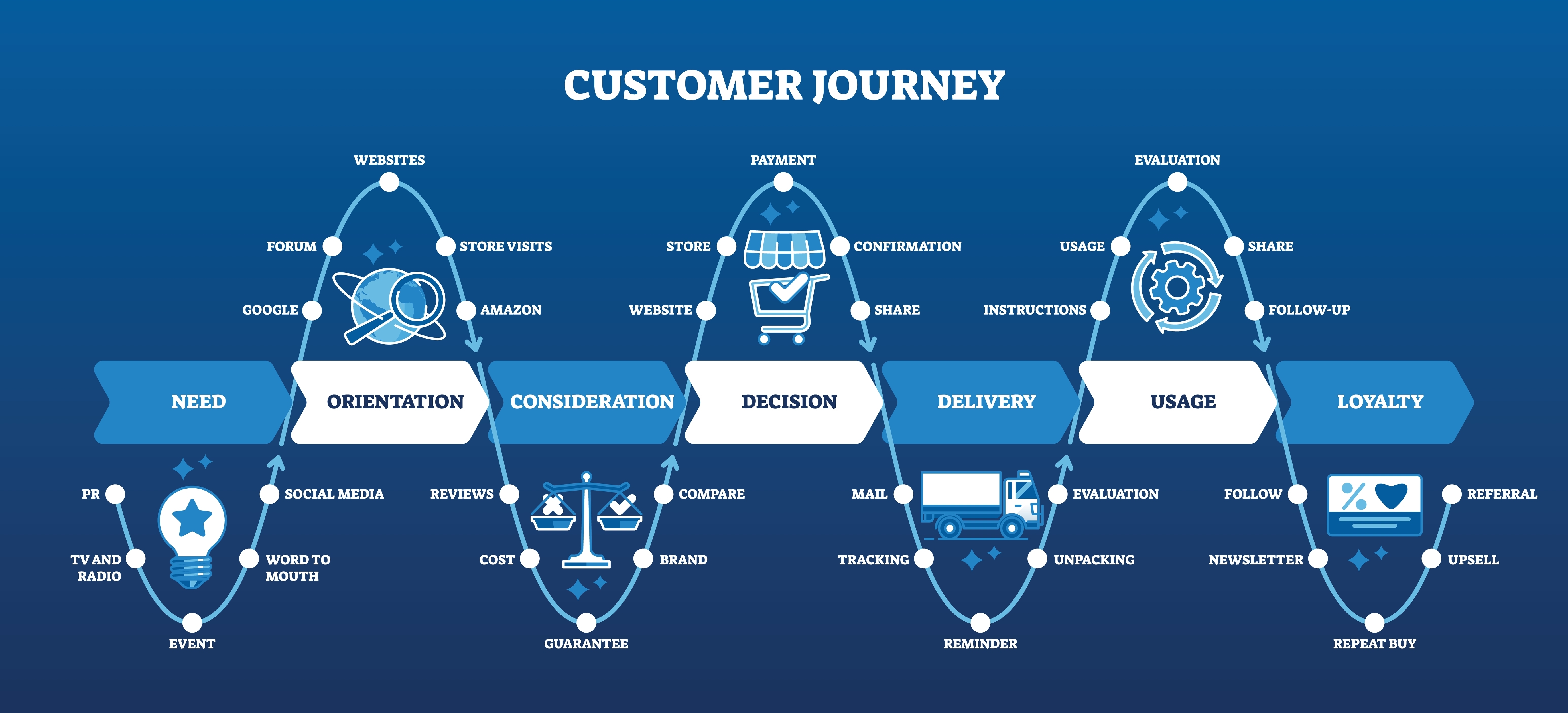
Most companies that invest in customer journey mapping end up with a beautifully illustrated PDF reviewed once at a leadership offsite, praised for its colour coding, and archived in SharePoint. The map becomes an artifact of intention rather than an instrument of revenue. That gap — between the map and the money — is the problem worth solving.
Customer journey mapping, done right, is not a design exercise. It is a revenue strategy.
It’s a P&L Lever, Not a UX Workshop
Companies with formal journey management programs see 54% greater return on marketing investment and are 2.2 times more likely to report increased customer lifetime value (Aberdeen Group). McKinsey puts the revenue impact at 10–15% growth alongside a 15–20% reduction in service costs. These are structural shifts, not marginal improvements.
When you understand the exact moments where customers hesitate, defect, or overspend, you can architect interventions at those moments rather than spray campaigns into the void. That architecture requires seven interlocking capabilities: a Customer Data Platform to unify identity and behaviour, a CRM to carry relationship context, Marketing Automation to trigger the right action at the right moment, Digital channels to reduce friction at scale, Campaign Management to coordinate messaging without fatigue, Call Centre intelligence to ensure the human layer doesn’t undo the digital experience, and Data Analytics to close the feedback loop.
These seven pillars either operate as a connected system — or they work against each other. There is no middle ground.
BFSI: Where Moments of Truth Carry Real Consequences
Account onboarding in the first 90 days is where banks lose customers — not because the product is wrong, but because the follow-through is broken. A customer opens a savings account digitally, receives a generic welcome email with no reference to their profile, then gets an inbound call from an agent with zero visibility into the digital application. A unified CDP collapses that silo. Institutions running automated onboarding sequences — CRM-triggered check-ins, in-app product introductions, direct deposit nudges timed to week two — report materially higher activation rates and lower early attrition.
The renewal window in insurance is the 60 days before a policy lapses, when the customer is most exposed to competitive comparison. Personalised renewal reminders drawn from CRM data on claims history, preferred channel, and life-stage signals convert at far higher rates than a generic blast. Layering CDP propensity scores to identify cross-sell candidates shifts the conversation from retention to product expansion in a single interaction.
Claims is the moment of maximum emotional exposure. Automated status updates, proactive outreach when a claim stalls, and agent dashboards surfacing the full cross-channel history are not differentiators — they are retention infrastructure. Institutions that deliver this report double-digit improvements in first-call resolution.
Automotive: Bridging the Research-to-Relationship Gap
The automotive customer spends an average of 14 hours researching online before entering a dealership. The moments that matter most occur in the digital-to-physical handoff — and most OEMs and dealer networks still handle it badly.
Lead to showroom conversion is where integrated data pays off most visibly. OEM programs that carry a customer’s online configurator activity, form submissions and test drive requests into the dealer CRM can achieve up to 75% uplift in lead conversion. The intelligence already exists. The integration is what’s missing.
The end-of-finance-term window is where analytics, campaign management and call centre coordination converge. Customers approaching the end of a PCP or lease — identified by analytics, reached across preferred digital channels, with the call centre briefed on their ownership history — represent the highest-probability upgrade opportunity in the brand relationship. Most dealers leave it to chance.
Post-purchase service re-engagement is the most undervalued retention lever in automotive. CRM sequences triggered by mileage estimates rather than calendar date make the outreach feel considered, not automated.
Retail: Loyalty Architecture vs. the Loyalty Illusion
The most dangerous assumption in retail is that a customer who has bought twice is loyal. Repeat purchase is a behaviour. Loyalty is a disposition.
Cart abandonment recovery is where CDP-powered segmentation earns its place. The price-sensitive shopper who needs a discount trigger and the intent-confirmed shopper who simply needs friction removed are not the same person. Sending them the same email is not personalisation — it is broadcasting with extra steps.
The at-risk loyalty member is where churn prediction creates genuine competitive advantage. CDP-fed models identify declining engagement two to three weeks earlier than traditional recency-frequency analysis — the difference between a timely offer and a win-back campaign landing in the deleted folder.
What Breaks When the Pillars Don’t Talk
When campaign management doesn’t read from automation outputs, customers receive contradictory messages within the same week. When the call centre operates on a separate system from digital channels, a customer who resolved a complaint online receives a retention offer by phone — reopening a wound that had healed. Many companies lose a lot of revenue to avoidable customer switching, much of it traceable not to product failure but to experience failure — disconnected interactions that signal the organisation doesn’t know its customers.
The Discipline That Separates Revenue from Research
Organisations generating outsized returns treat the map as a living operational asset, not a documentation exercise. Journey performance is tracked alongside revenue and NPS. Cross-functional ownership — marketing, technology, analytics and operations — ensures insight translates to intervention, not observation.
The provocation: pull up your last customer journey map and count how many identified pain points have been resolved in the past 12 months. If the answer is fewer than half, you don’t have a journey strategy — you have a research habit. The map is not the treasure. The discipline to act on it is.