
In early February 2026, $285 billion in market value evaporated from enterprise software and IT services firms worldwide. The trigger? Anthropic’s enhanced Claude agent and OpenAI’s Frontier platform demonstrated that AI could now autonomously execute workflows that once required armies of developers and specialized SaaS platforms. Wall Street called it the “SaaSpocalypse”.
The truth, as always, lies in the nuance—and reveals why the transformation underway is more profound than markets initially grasped.
The Panic: When AI Agents Became Real
Anthropic unveiled Claude Cowork with eleven specialized plugins for legal research, sales, marketing, and data analysis—production-ready automation that previously required both SaaS platforms and implementation services. Days later, OpenAI announced Frontier, designed to orchestrate AI agents across Salesforce, Workday, SAP, and internal databases.
India’s Nifty IT index crashed 8%—its worst day since March 2020—erasing ₹2 lakh crore. TCS hit five-year lows. The fear was existential: if AI agents can write code, manage workflows, and execute business processes autonomously, what happens to a $254 billion industry built on labor arbitrage?
Why the Panic Was Overblown
SaaS didn’t eliminate custom development: Despite decades of powerful SaaS tools, enterprises still needed developers for custom applications. Cloud migration created more work, not less, as companies needed expertise in containerization, Kubernetes, microservices, and cloud security.
Enterprise complexity remains: AI agents can’t automatically handle data governance, regulatory compliance, security protocols, system integration, change management, and cloud cost optimization. Someone must customize workflows, manage approval hierarchies, monitor performance, and ensure continuous security.
Indian IT is building the agents: What markets missed is that Indian IT companies aren’t victims—they’re actively building 500+ AI agents themselves. They’re adopting tools like GitHub Copilot, developing proprietary platforms (Infosys Topaz, Wipro Intelligence, TCS AI Platform), and reimagining workforces around human-AI collaboration.
Why the Threat Is Still Real
The productivity revolution is genuine. Recent data confirms:
- 72% of engineers use GenAI tools; 23% report 50%+ productivity gains
- GitHub Copilot users’ complete tasks 55% faster
- McKinsey shows code documentation in half the time, new code in nearly half the time
- EY projects 43-45% productivity enhancement in India’s IT sector over five years
Execution roles face extinction: 40% of India’s 375,000 testing/QA professionals perform functions now highly susceptible to automation. Entry-level testing roles could disappear within two to five years. An IIM Ahmedabad study found 68% of white-collar employees anticipate partial or full automation within five years.
The economics are flipping: When AI drops development costs 60-70%, why pay legacy SaaS prices? When agents perform work of multiple humans, per-seat licensing collapses. OpenAI’s Frontier asks: why pay for 50 Salesforce licenses when 5 AI agents handle the same workflows ?
The Man Behind the Disruption
Rahul Patil, a PESIT Bengaluru graduate and Anthropic’s CTO since October 2025, architected Claude’s enterprise capabilities. His obsessive focus on infrastructure, reliability, and cost cut the “cost per token” dramatically, enabling Anthropic to bypass software middlemen and sell directly to enterprises.
Wall Street calls it the “Patil effect”: cheaper inference enabling platform displacement. Anthropic is now opening its second global office in Bengaluru, where Claude usage has risen five-fold. The irony is profound: a Bengaluru native leading the AI revolution that transforms—and threatens—his hometown’s IT boom.
The Strategic Pivot: From Headcount to Hybrid
Indian IT’s response has been decisive:
Microsoft’s Frontier Firms: TCS, Infosys, Wipro, and Cognizant were designated “Frontier Firms”—organizations redesigning workflows around AI-human collaboration. Infosys CEO Salil Parekh: “We are shifting from traditional workflows to a human+ agent powered AI-first enterprise”.
Massive upskilling investment: Accenture invests $1 billion annually, training 500,000+ employees in AI fundamentals, building a 75,000+ data and AI workforce. CHRO Lakshmi Chandrasekaran emphasizes: “Human skills matter more than ever—learning agility, adaptability, resilience, empathy, and ethical reasoning”.
The 500+ agent economy: Indian IT is building 500+ AI agents, positioning as creators and orchestrators of the technology markets feared would destroy them.
Hybrid pods: EY’s “AIdea of India 2026” report describes the new model: “Hybrid pods of humans and AI Agents collaborate, combining precision and scale to expand capacity without adding headcount”. Human oversight ensures transparency, accountability, and alignment with ethics.
How is Hansa Cequity Navigating the Transition
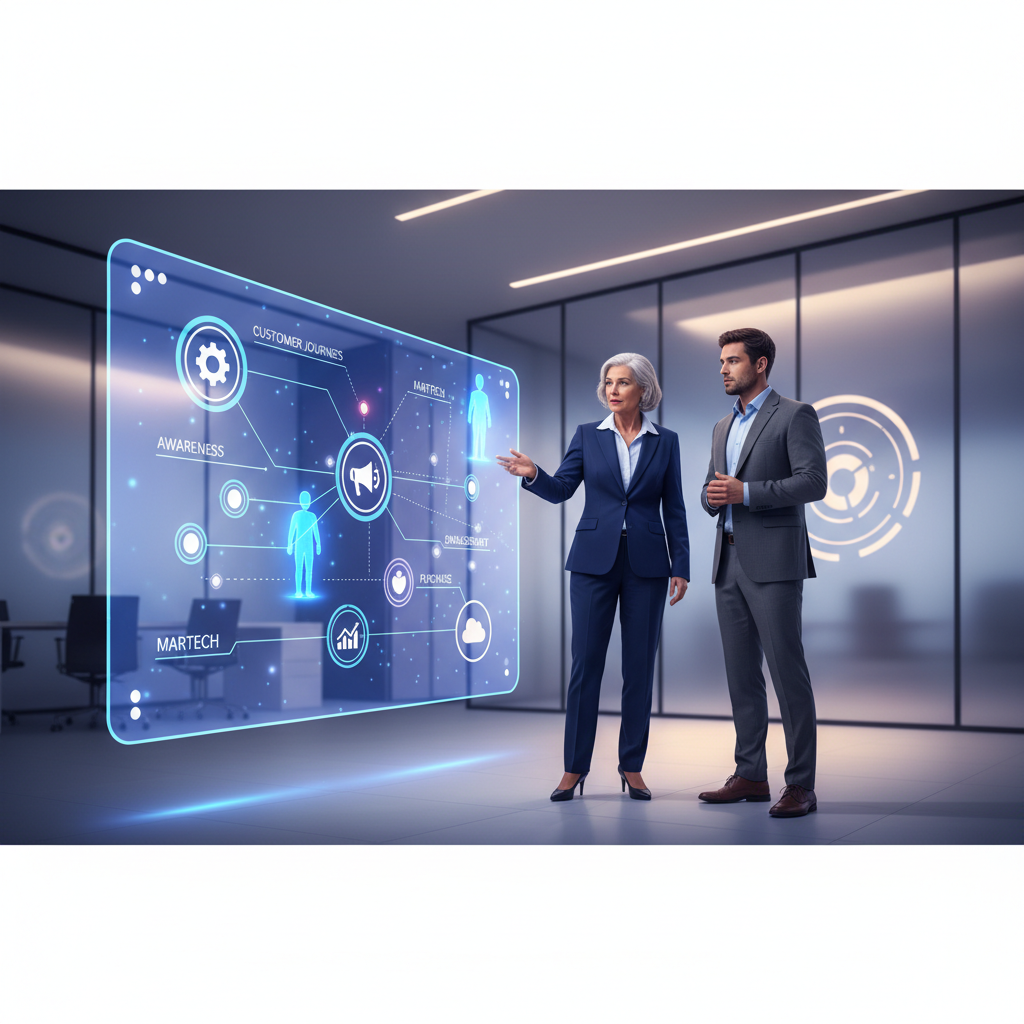
While large IT services players have the resources to invest billions in AI transformation, mid-sized specialized firms face a different challenge—and opportunity. Hansa Cequity, exemplifies how niche players are positioning for the AI agent era.
Rather than competing on scale or lowest cost, Hansa Cequity is doubling down on domain expertise that AI agents cannot easily replicate: deep understanding of martech stack orchestration across 50+ platforms, proprietary frameworks for customer journey optimization in regulated industries like financial services, and governance models for AI-driven personalization that balance effectiveness with privacy compliance.
The strategic pivot centers on three pillars. First, building AI orchestration capabilities specifically for marketing and customer experience use cases—helping CMOs evaluate which martech tools can be replaced by agents versus which provide genuine differentiation. Second, developing hybrid delivery models where AI agents handle routine campaign execution, data integration, and performance reporting while human strategists focus on creative direction, brand positioning, and complex customer insights. Third, positioning as trusted advisors on the ethical deployment of AI in customer-facing applications—navigating the nuanced territory of algorithmic personalization, consent management, and brand risk. Rather than viewing AI as existential threat, the approach treats it as force multiplier that enables Hansa Cequity to deliver enterprise-grade solutions with leaner teams, competing on expertise depth rather than headcount scale.
What Endures: The Defensible Moats
Enterprise complexity: 64% of Indian enterprises cite data governance and security as “very severe” challenges; 78% struggle with system integration. Real enterprise environments are messy—legacy systems, regulatory compliance, fragmented data, multi-layered security.
Domain expertise: Generic AI handles generic tasks. Understanding banking regulations, healthcare claims processing nuances, or pharmaceutical supply chain cold chain management requires deep expertise AI hasn’t mastered.
Trust and governance: Autonomous agents require frameworks for alignment, transparency, bias mitigation, regulatory compliance, audit trails, and human oversight—capabilities that combine technical AI expertise with legal knowledge, organizational design, and change management.
Human judgment: Complex strategy, crisis management, ethical dilemmas, and high-stakes negotiations require human empathy, creativity, and contextual understanding.
The Path Forward
For SaaS Companies
- Shift to outcome-based pricing: Stop selling access; sell guaranteed results
- Build AI-native products: Redesign architecture around agents, not bolted-on features
- Prioritize profitability: The cash-burning era is over
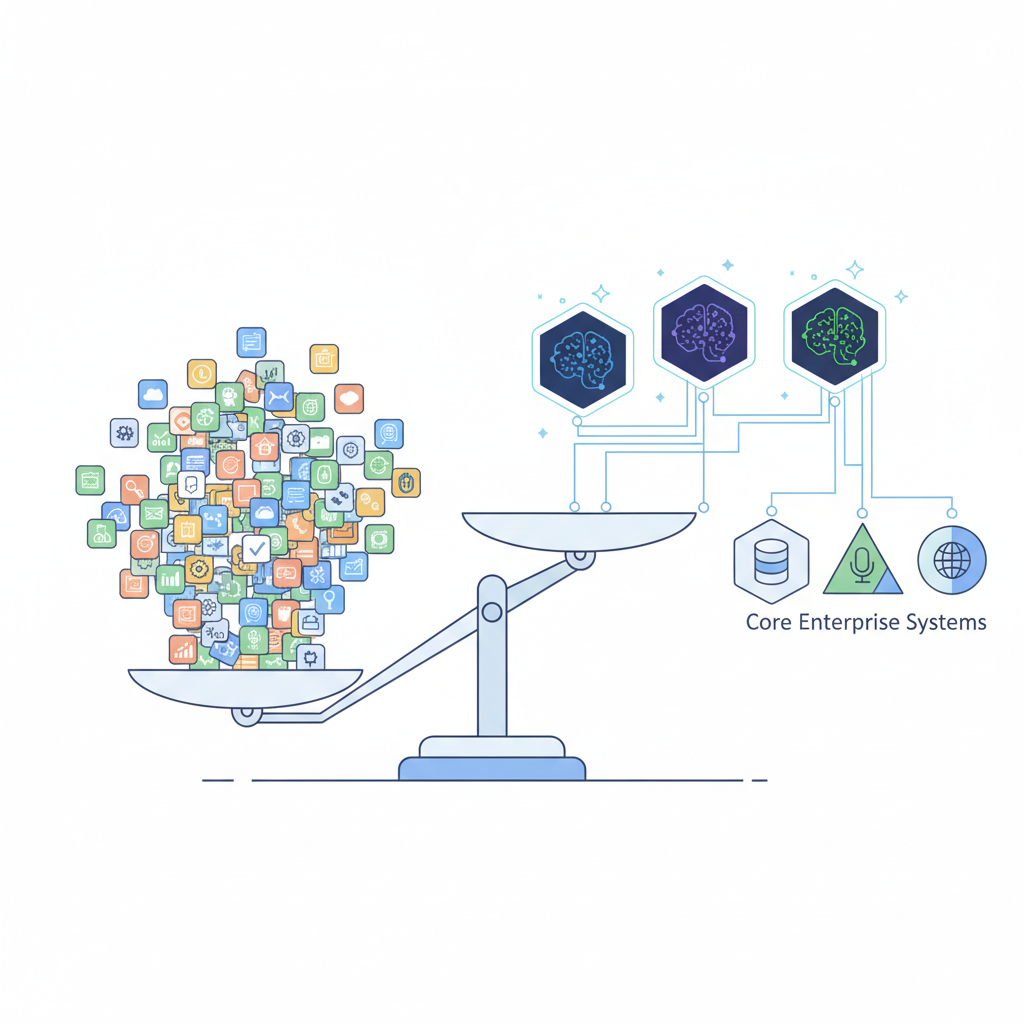
- Consolidate to reduce vendor sprawl: Help enterprises reduce from 500+ SaaS vendors
For IT Services Providers
- Transform to capability building: Build proprietary frameworks, not just supply developers
- Develop AI orchestration expertise: Become the trusted guide navigating AI complexity
- Create hybrid delivery models: Combine AI speed with human judgment
- Invest in upskilling and reskilling
- Build agents, don’t just consume them
- Move up the value chain: Shift from execution to architecture, implementation to strategy
- For specialized firms, double down on domain depth: Compete on expertise and governance, not scale
For Enterprises
- Rationalize SaaS stacks: Many enterprises can reduce spending 30-50% by replacing point solutions with AI agents
- Reassess build vs. buy: Custom development barriers have dropped dramatically
- Invest in AI literacy: This is business model transformation, not just technology
- Address governance first: Data quality, integration, and security are prerequisites
- Reimagine workflows: Highest value comes from rethinking how work should be done, not automating inefficiency
Conclusion: Disruption, Yes—Apocalypse, No
The $285 billion wipeout was rational repricing based on genuine disruption. When development productivity increases 50%+ and AI agents execute complex workflows autonomously, the value chain must reconfigure.
But Indian IT has survived massive disruptions before—Y2K, dot-com crash, cloud migration, agile transformation. Each time, conventional wisdom predicted collapse. Each time, the industry adapted. The current transformation is more profound because it touches human labor itself: 40% of testing roles face extinction within five years.
Yet the new model—orchestrating agents, building governance frameworks, guiding transformation, creating hybrid human-AI pods—offers higher margins and more strategic relationships than traditional staff augmentation. Microsoft’s “Frontier Firms” aren’t those with the most developers or lowest rates; they’re those building AI-first operating models.
There’s profound irony: Rahul Patil, a Bengaluru native, leads Anthropic’s enterprise push from his hometown. As Anthropic opens its Bengaluru office and Claude usage rises five-fold in India, the city that powered IT’s boom navigates its deepest reinvention.
This wasn’t an apocalypse—it was forced evolution: from headcount to hybrid pods, from labor arbitrage to AI orchestration, from executing tasks to reimagining workflows, from selling time to delivering outcomes.
As Zoho’s Sridhar Vembu warned, AI is “the pin popping this inflated balloon” of software economics built on scarcity. But what emerges isn’t wasteland—it’s a fundamentally different structure where human expertise combines with AI agents, where governance commands premium pricing, and where adaptability matters more than scale.
For firms with courage to cannibalize their models, vision to reimagine value creation, and discipline to invest billions in upskilling, this reset is generational opportunity. For those clinging to pre-AI assumptions, the SaaSpocalypse may yet prove prophetic.
The balloon has popped. Indian IT—bloodied but adapting—appears positioned not just to survive, but to architect the AI agent era